DJI Drone Import in India: What the DGFT and Customs Rules Actually Say
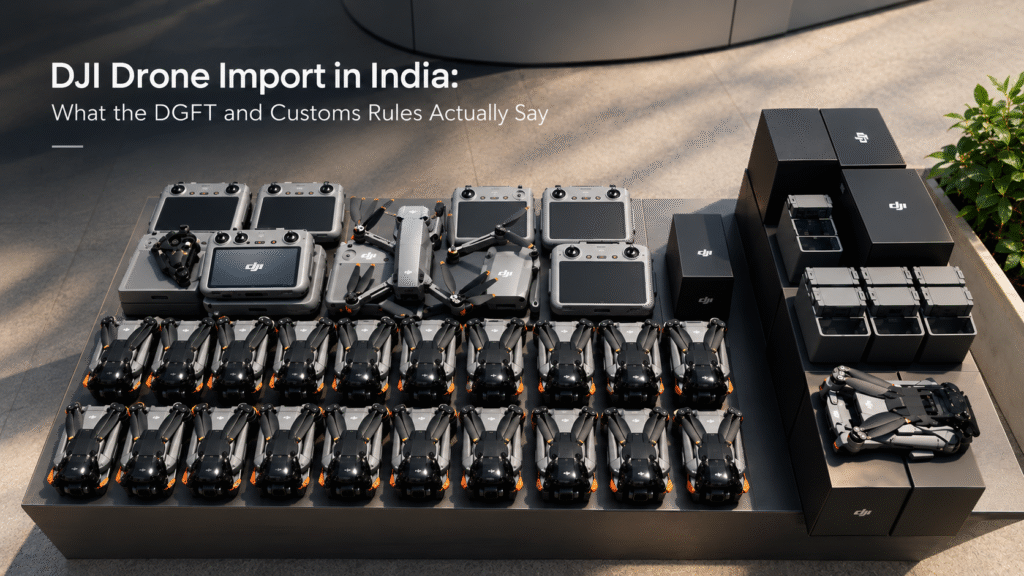
So you’ve found the DJI drone you want, you know the price, and now you’re stuck on one question: can you actually get it into India? This is where a lot of buyers run into trouble not because the drone itself is a problem, but because DJI drone import in India works differently from importing most other electronics.
Before you place that order from an overseas seller, it’s worth understanding what DGFT, customs, and DGCA each control. They’re not the same thing, and mixing them up is how people end up with a drone stuck at customs or, worse, one they can’t legally register or fly.
What DGFT Actually Restricts
Since 2022, the Directorate General of Foreign Trade has kept a tight rule in place: complete drones whether they arrive Completely Built-Up (CBU), Semi-Knocked Down (SKD), or Completely Knocked Down (CKD) are prohibited from import, with exceptions.
Those exceptions cover government bodies, recognised educational institutions, approved R&D organisations, manufacturers importing for R&D, and defence or security use, and even then, the right DGFT authorisation is needed first.
Individual drone components, on the other hand, are freely importable. That’s a meaningful gap, and it’s exactly why some businesses choose to source components rather than a finished unit.
Is It Legal to Import a DJI Drone Into India?
For a straightforward commercial purchase, it depends on what form the drone arrives in and why you’re bringing it in.
A few things worth checking before you assume an import is fine:
- The exact model and how it’s classified
- Whether it falls under the CBU/SKD/CKD restriction
- Your intended use for the drone
- Whether any DGFT authorisation applies to your situation
- Current DGCA requirements for that drone category
Paying customs duty doesn’t automatically make an otherwise restricted import legal. Customs clearance and import eligibility are two separate hurdles, and clearing one doesn’t clear the other.
DJI Drone Customs in India - What You'll Actually Need
Once the import policy question is settled, customs has its own paperwork requirements. Typically, that means:
- Commercial invoice and packing list
- Airway bill or shipping documents
- Importer details and product description
- Classification information for the product
- Authorisation documents, where the drone requires one
The exact list shifts depending on the shipment and the importer, so treat this as a starting point rather than a fixed checklist. And don’t make the mistake of focusing only on DJI drone customs duty in India while ignoring whether the drone can be imported at all duty calculations mean nothing if the import itself isn’t permitted.
Can You Just Carry a DJI Drone From Abroad as Baggage?
This comes up constantly. Someone buys a drone in Dubai or the US, packs it in their luggage, and assumes personal possession sidesteps the paperwork. It doesn’t.
The DGFT restriction applies to CBU, SKD, and CKD drones regardless of how they enter the country, carried in a suitcase or shipped by freight. If you’re travelling with drone equipment, check current customs requirements before you fly.
Drone vs. Everything Else in the Case
It also helps to separate the drone body from its accessories; batteries, controllers, cameras, and spare parts can sit under different rules than the drone itself, so don’t assume one policy covers the whole kit.
DGFT vs. DGCA: Two Different Questions
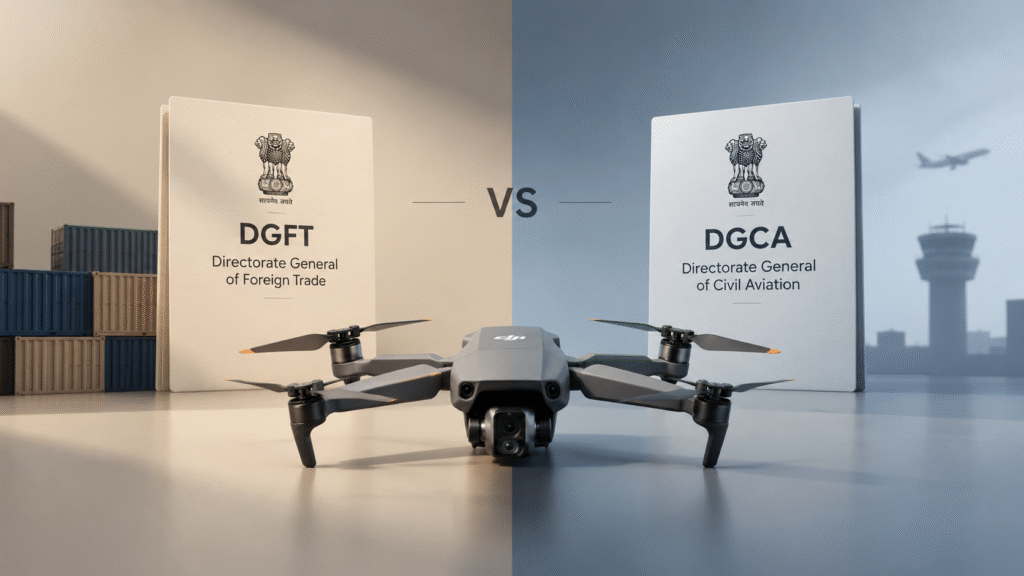
People often treat “can I import it” and “can I fly it” as the same question. They’re not.
DGFT decides whether the product can legally enter the country and what authorisation, if any, is required.
DGCA governs what happens after that registration, certification, and actual operation. Worth noting: the DGCA’s platform currently shows that registration of non-type-certified UAS is on hold until further notice, so this is one to verify directly with them before you plan any operation around a specific drone.
Registration and Flying Legally
Getting a drone through customs is only step one. Under the Drone Rules, 2021, most unmanned aircraft systems need registration and a Unique Identification Number before they can be flown, unless a specific exemption applies.
Before you plan to fly commercially, check where things currently stand on:
- Drone category and type certification
- Registration and UIN
- Remote pilot requirements
- Airspace restrictions and operational permissions
- Digital Sky / eGCA processes
Rules here shift, so treat the DGCA’s own site as the reference point rather than something you read once and file away.
Drone Components: The Easier Path
If your business is involved in assembly, repair, maintenance, or R&D, it’s worth knowing that individual components are classified as free to import; no CBU/SKD/CKD restriction applies to them. You’ll still need to classify products correctly and meet standard customs and tax requirements, but the path is considerably less complicated than importing a finished drone.
A Quick Checklist Before You Buy
Before ordering a DJI drone from an overseas seller:
- Check the current DGFT import policy not an old blog post or a seller’s claim
- Confirm whether you’re importing a complete unit or components
- Nail down your intended use (commercial, R&D, education, government, defence)
- Check DGCA requirements separately from import eligibility
- Keep invoices, serial numbers, and product documentation on hand
- Factor customs and taxes into your actual budget, not just the sticker price
Why Working With a Local Supplier Makes This Easier


A lot of this complexity disappears when you buy through a supplier who already deals with professional drone requirements in India. Instead of navigating international shipping, classification questions, and import uncertainty on your own, you’re working with someone who’s already done it.
For applications like surveying, mapping, thermal inspection, or infrastructure monitoring, picking the right model matters as much as getting the import right the DJI Matrice series, for instance, is built for exactly this kind of enterprise use. Choose based on what the job actually needs, not just what’s newest.
Dronevex works with businesses across India that need DJI enterprise and specialised drone technology, and can help you sort through model selection and regulatory questions before you commit to a purchase.
Frequently Asked Questions
Can I import a DJI drone into India
Complete drones in CBU, SKD, or CKD form are currently restricted under DGFT policy, with exceptions for specific categories and authorisations. Components are free to import.
Can I bring a DJI drone from Dubai or the USA in my luggage?
Carrying it as baggage doesn’t bypass the import rules. Check DGFT and customs requirements before you travel with a complete drone.
Do I have to pay customs duty on a DJI drone?
Duty depends on classification and circumstances, but paying it doesn’t make a restricted import legal on its own.
Are DJI drones legal to fly in India?
That depends on registration, certification, and operational rules, which are separate from import rules entirely.
Can drone components be imported without restriction?
Yes, components are classified as free to import under the current DGFT policy.
Does DGCA approval cover import as well as flying?
No. DGFT handles import eligibility; DGCA handles certification, registration, and operation. They need to be checked independently.
Can businesses legally operate DJI drones commercially in India?
Yes, once the applicable DGCA requirements for that drone and use case are met. Check current requirements before starting operations.