How to Get a Drone License in India (2026): Step-by-Step Guide
If you want to fly a drone for money in India, sooner or later a client will ask: “Do you have a DGCA license?” The official name is a Remote Pilot Certificate (RPC). It replaced the old drone pilot licence in 2022, but almost everyone, clients included, still calls it a drone license.
The good news is that it isn’t hard to get. There’s no entrance exam, you don’t need to have flown before, and the training takes about a week. Here’s how it works in 2026, one step at a time.
Already know you want to start? Have a look at our drone pilot training courses and this week’s batches.
First, Do You Actually Need a Drone License?
It comes down to two things: how heavy your drone is, and whether you’re being paid to fly it. DGCA sorts drones into five classes by all-up weight, which means the drone plus its battery and whatever it’s carrying.
| Category | All-up weight | RPC needed? |
|---|---|---|
| Nano | Up to 250 g | No |
| Micro | 250 g to 2 kg | Only for commercial use |
| Small | 2 kg to 25 kg | Yes |
| Medium | 25 kg to 150 kg | Yes |
| Large | Above 150 kg | Yes |
So a sub-250 g camera drone doesn’t need an RPC at all, even for paid work. Step up to anything heavier for weddings, real-estate shoots, surveys, inspections or crop spraying, and you do. Most people who get serious about drones end up flying something above 250 g, which is why most of them end up taking the course.
Who Can Apply?
The bar is kept low on purpose. You need to:
- Be between 18 and 65 years old.
- Have passed Class 10 or an equivalent exam.
- Complete a DGCA-approved course at an authorised training school (an RPTO, or Remote Pilot Training Organisation) and pass its tests.
That’s the whole list. No flying experience, no engineering degree. Every course starts from zero, and you’ll spend time on a simulator before you touch a real drone.
Documents to Keep Ready
- Aadhaar, passport or another government photo ID
- Your Class 10 marksheet or certificate
- A couple of passport-size photographs
- A mobile number and email address you actually check, because your certificate is linked to your account on DGCA’s eGCA portal
Some training schools also ask for a basic medical fitness certificate. Ask when you book, so it doesn’t hold you up on day one.
How to Get Your Drone License, Step by Step
Step 1: Pick the right category
Most people start with the Small category RPC, which covers drones from 2 to 25 kg. It suits photography, survey and inspection work. If you want to fly heavy agricultural sprayers or payload drones, look at the Medium category, or a combined Small + Medium course, which usually costs less than doing the two separately.
Not sure which one fits? Our course finder matches courses to what you want to do.
Step 2: Choose a DGCA-authorised training school (RPTO)
Only an RPTO authorised by DGCA can train you for an RPC, and DGCA publishes the list of authorised schools. Check that yours is on it before you pay anything.
After that, compare the things that actually shape your week:
- How many trainees share each drone and instructor
- How much time you’ll get on the sticks yourself
- Which drones you’ll train on (ideally the class you plan to work with)
- Batch dates, and how far you’ll need to travel
Step 3: Ground school, simulator and real flying
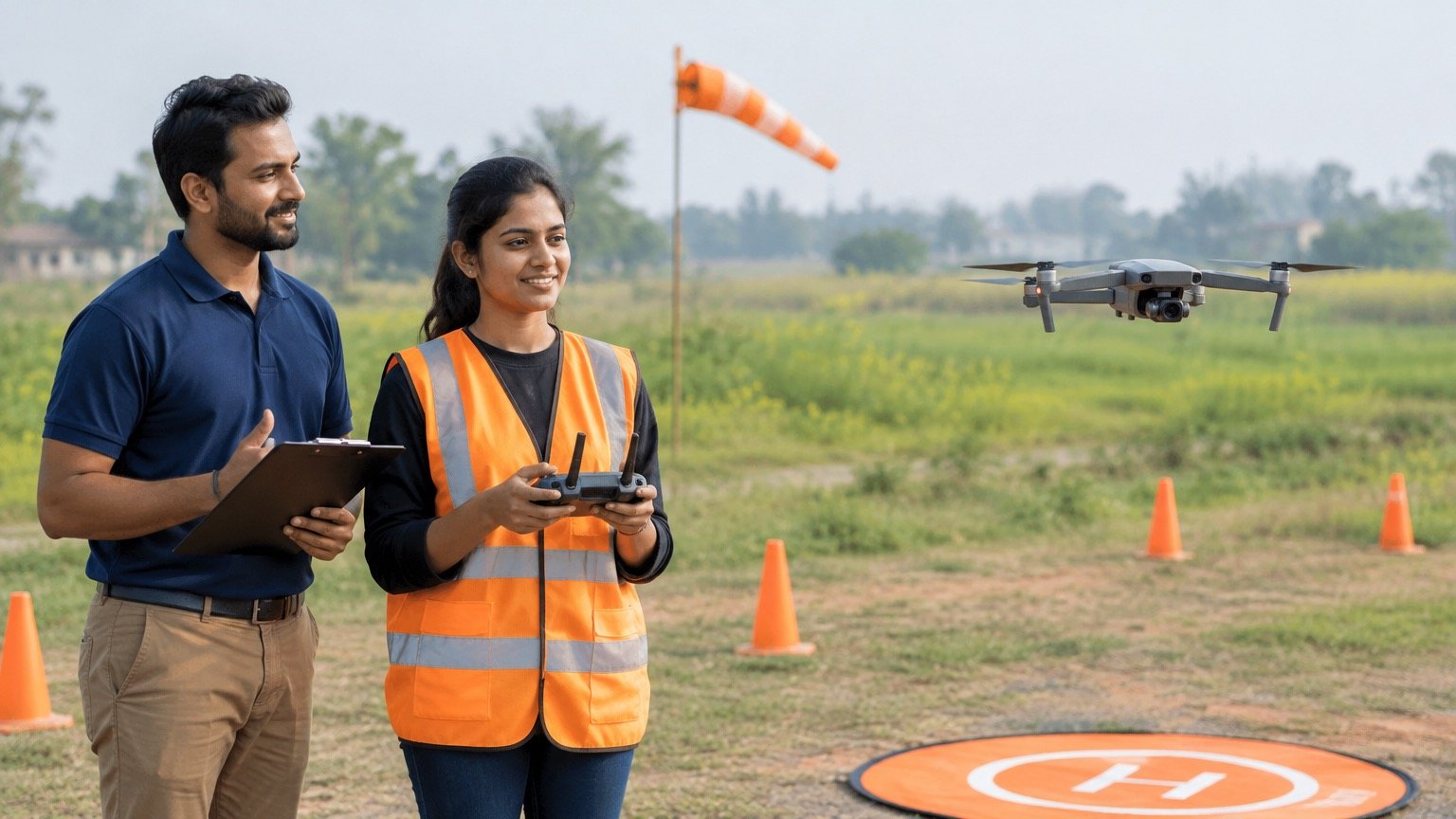
A Small category course usually runs about five days, though some schools spread it over seven. Expect roughly this:
- Ground school: the Drone Rules, airspace zones, weather, air traffic control procedures and how drones work.
- Simulator: getting a feel for the controls and practising emergencies without risking a real aircraft.
- Live flying: with an instructor beside you, from simple hovering to flight patterns, GPS and ATTI (manual) modes, and return-to-home.
ATTI mode is where most beginners struggle, because the drone stops holding its position for you. It usually clicks after a few sessions.
Step 4: Pass the tests
At the end of the course you take a theory test and a practical flying test at the RPTO. If you’ve paid attention all week, neither should worry you. The practical test is mostly about smooth, controlled flying and following the procedures you’ve practised.
Step 5: Get your Remote Pilot Certificate
Once you pass, the RPTO issues your Remote Pilot Certificate online through DGCA’s eGCA portal. Pilot certificates and drone registration moved there from the older DigitalSky platform in July 2025, so there’s no separate trip to a DGCA office.
The government fee for the certificate is just ₹100, and it stays valid for 10 years. After that, you can renew it.
What to Do After You Get Your License
The certificate lets you fly, but a few more things keep you legal:
- Register your drone. It needs a Unique Identification Number (UIN), which you apply for on eGCA.
- Check the airspace map before every flight. The DigitalSky map shows green zones (fly up to 400 ft without permission), yellow zones (you need air traffic control permission) and red zones (central government permission only). Around airports and big cities, the zone can change from one neighbourhood to the next.
- Get third-party insurance. The Drone Rules require it for every drone except nano drones, and clients will ask for it.
- Keep flying. Logged hours and a specialist skill, like mapping, thermal inspection or spraying, are what clients really pay for.
What Does It Cost, and Is It Worth It?
Small category courses at authorised RPTOs usually cost ₹25,000 to ₹35,000 plus GST. We’ve broken down every cost in Drone Pilot License Cost in India. And if you’re wondering whether it pays off, our drone pilot salary guide covers what certified pilots earn and which jobs pay best.
Train at a DGCA-authorised partner RPTO near you. Small, Medium, Agriculture and Instructor courses, with new batches every week.
See Courses & Fees →Find Training Near YouFrequently Asked Questions
Is a drone license mandatory in India?
For most paid work, yes. You need a Remote Pilot Certificate to fly a micro drone (250 g to 2 kg) commercially, and to fly any small, medium or large drone. Nano drones, and micro drones flown just for fun, are exempt.
How long does it take to get a drone license?
The Small category course takes about five days (seven at some schools), including the tests. Once you pass, the RPTO issues your certificate online on DGCA’s eGCA portal.
What is the minimum age for a drone license in India?
18. You can hold a Remote Pilot Certificate from 18 to 65, and you need to have passed Class 10 or equivalent.
How long is a drone license valid?
A Remote Pilot Certificate is valid for 10 years, and you can renew it after that.
Can I get a drone license online?
Not completely. The certificate is issued online, but the training and the flying test have to be done in person at a DGCA-authorised RPTO. Be wary of anyone offering a drone license without real flying.