DJI Dock 4: The Battery-Swapping Drone Dock Built for 24/7 Operations
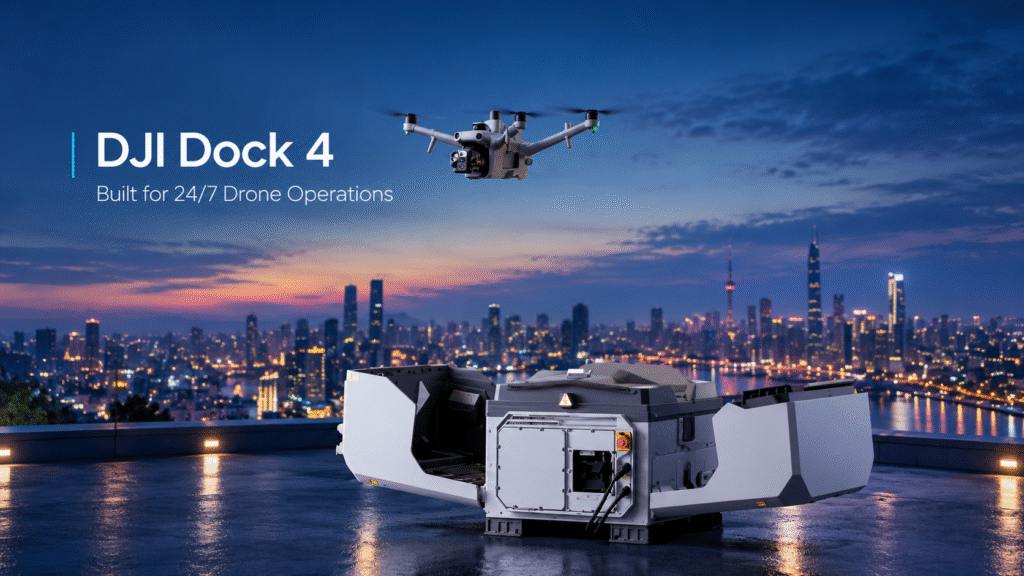
Most drone programmes lose their biggest advantage to one thing: waiting for batteries to charge. DJI’s new Dock 4 targets that problem directly. It is DJI’s first dock that swaps batteries automatically, putting the Matrice 5TD back in the air in under 45 seconds. For Indian industries running plants, pipelines, mines, solar farms and campuses, that could change how autonomous drone missions work.
Here’s what Dock 4 is, what’s new, and where it fits.
What Is DJI Dock 4?
A drone dock, often called a “drone in a box,” is an automated station where a drone takes off, lands, and gets serviced with no operator on site. DJI launched Dock 4 and the Matrice 5TD on October 14, 2026. It is the fourth generation of the DJI Dock series. DJI says the series is already used in more than 80 countries and regions, with over 8 million flights logged. pickdrones
The system pairs the dock with a purpose-built aircraft, the Matrice 5TD, and is managed remotely through DJI FlightHub 2.
The Big Upgrade: Battery Swapping
Earlier DJI docks charge the battery while it stays inside the landed drone. DJI says that takes about half an hour. Dock 4 removes that wait. interestingengineering
The dock swaps in a fresh pack in under 25 seconds, and the drone stays powered on throughout. It has four bays but only three batteries; the empty bay catches the used pack, which recharges for the next swap. The result is a landing-to-takeoff turnaround under 45 seconds.
That matters in real operations. If an alarm triggers at a perimeter or a fault appears on a power line, the drone can launch again almost immediately instead of sitting idle mid-charge. Over a day, the gain in usable flight time adds up quickly.
Meet the Matrice 5TD
Dock 4 works only with the Matrice 5TD. DJI states it is compatible only with this aircraft. The drone is built for demanding missions: dji
- Flight time: up to 59 minutes per flight
- Sensors: four cameras, including a thermal camera and an 11x super telephoto lens, plus a laser rangefinder with a 3 km range
- Onboard intelligence: LiDAR, radar and AI that spots 17 kinds of targets
Thermal imaging and long-range zoom make it useful for night patrols, search operations and spotting equipment faults from a safe distance.
Built for Tough Conditions
India’s operating conditions vary from Rajasthan summers to Himalayan winters, so durability matters. Dock 4 is rated IP56 and operates from -40°C to +50°C. DJI notes these figures come from controlled tests and real-world performance varies with the environment. Treat them as a strong starting point, and run a site survey before committing to a location.
Easier Upgrades and Integration
Dock 4 uses the same 400 x 400 mm mounting pattern as Dock 3, which should simplify upgrades at existing sites. On the software side, DJI introduced Cloud API 2, which helps enterprises and developers integrate the dock into existing business systems. For companies with their own dashboards or security platforms, that is a significant advantage.
Where Dock 4 Fits
Industrial and perimeter security. Automated patrols and instant dispatch when an alert fires, with thermal vision for night coverage.
Energy and utilities. Regular inspection of solar farms, substations and transmission corridors without sending crews to remote sites.
Mining and infrastructure. Repeatable surveys and site monitoring across large, hard-to-reach areas.
Emergency response. Fast aerial eyes on an incident while teams are still on the way.
Things to Consider Before Buying
Dock 4 is powerful, but it’s an enterprise investment. In China the kit costs about 25,000 dollars, with software and support extra. Indian pricing will differ, so ask for a current quote. Also remember that remote dock operations generally depend on BVLOS approval, so plan for regulatory permissions under India’s drone rules early in the project.
The Dronevex team can help with use-case assessment, site planning, integration and compliance guidance.
Frequently Asked Questions
How is Dock 4 different from Dock 3?
The main change is automatic battery swapping. Dock 3 recharges the battery inside the drone, while Dock 4 swaps it in about 25 seconds. DJI puts the turnaround at under 45 seconds, down from roughly 27 minutes for Dock 3.
Which drone works with Dock 4?
Only the DJI Matrice 5TD. Older Matrice models used with earlier docks are not compatible.
Can Dock 4 operate without human supervision on site?
Yes. Takeoff, landing and battery swaps are automated, and missions are planned and monitored remotely through FlightHub 2. A remote pilot or operator still oversees the mission, and regulatory approvals apply.
Does Dock 4 need the O4 Ground Station?
Yes. It is required for video transmission and connectivity.
How do I buy Dock 4 in India?
DJI says to contact your local dealer. You can get in touch with Dronevex for availability, pricing and a deployment consultation.