Unitree H1: What this Humanoid Robot can actually do
Walk into most factories or warehouses today and you’ll still see robots bolted to the floor, arms that weld the same seam or move the same box thousands of times a day, never leaving their station. That’s been the industrial robot for decades: brilliant at one thing, useless at anything else.
Unitree’s H1 is a bet on something different. Instead of building the environment around the robot, the idea is to build a robot that can move through the environments we already have hallways, stairs, loading docks, cluttered warehouse floors; the same way a person would.
That’s a much harder problem than it sounds.
Why Walking Is the Hard Part
Wheels are easy. Legs are not. A wheeled robot doesn’t have to think much about balance — it just rolls. A bipedal robot is constantly falling and catching itself, hundreds of times a minute, adjusting its posture on the fly as the floor tilts, a foot slips, or someone bumps into it.
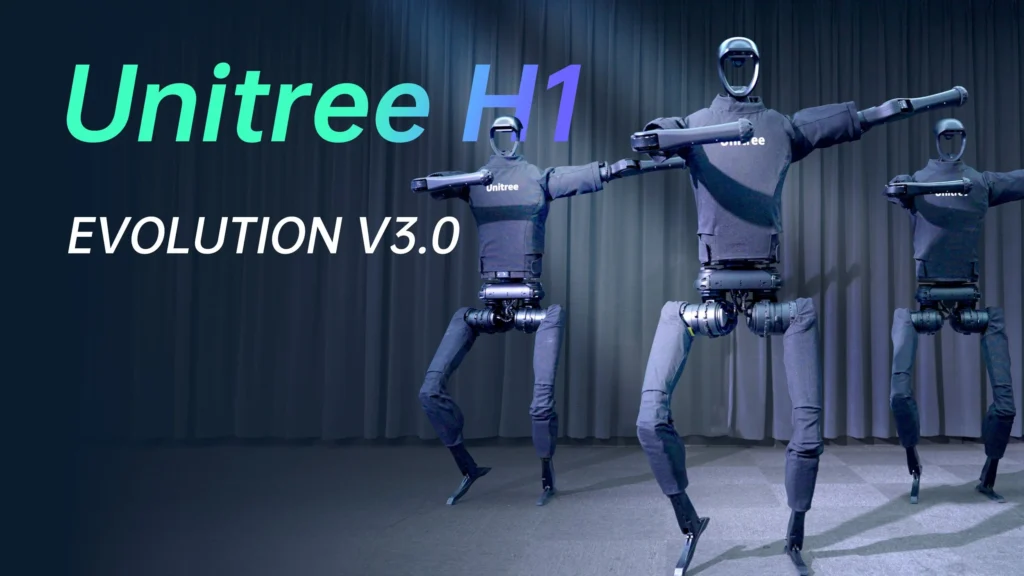
H1 handles this with a dense network of joint motors, sensors, and a control system that’s recalculating balance in real time. Get this wrong and the robot faces down. Get it right, and you’ve got a machine that can go anywhere a person can — through a doorway, up a ramp, across a warehouse floor that was never designed with robots in mind.
Unitree has also pushed hard on raw speed here. Most humanoid robots move cautiously, almost tentatively, because speed makes balance harder to maintain. H1 is built to move quickly without losing its footing — which matters more than it might seem, since a robot that shuffles along at a fraction of walking pace isn’t going to be much use on a real production floor.
Hands, Eyes, and a Body That Can Actually Do Something
Legs get a robot somewhere. Arms are what let it do something once it’s there.
Unitree H1’s arms are built for picking things up, carrying them, and setting them down — the basic vocabulary of physical work. Cameras and other sensors feed it information about what’s around it, which objects are where, and how to move without walking into a shelf or a person.
None of this makes Unitree H1 autonomous in any deep sense yet. But it’s the groundwork: a robot that can see, balance, walk, and grab is a robot you can eventually start giving real instructions to, rather than pre-programming every single movement.
Where a Robot Like This Actually Gets Used
Factories and assembly lines. Fixed robotic arms aren’t going anywhere — they’re too efficient at repetitive tasks to replace. But a humanoid robot could fill the gaps between them: carrying parts from one station to another, tending machines, doing visual inspections, handling the physical grunt work that doesn’t fit neatly into a fixed workstation.
Warehouses. This is arguably the most natural fit. Warehouses are already built for people — aisles, shelves, doors sized for human bodies. A robot that walks and grabs can, in theory, use that same layout without any retrofitting: pulling items, moving packages between zones, filling in during peak periods.
Universities and research labs. Long before H1 shows up on a factory floor at scale, it’s showing up in robotics labs, where researchers use it to study locomotion, control systems, computer vision, and human-robot interaction. For students, it’s a rare chance to work with a real bipedal platform instead of just simulating one.
Hazardous environments. Sending a robot instead of a person into a space with heat, chemical exposure, or structural risk is an old idea in robotics — think bomb disposal units or reactor inspection drones. A walking, manipulating robot extends that idea into spaces a wheeled robot can’t reach. Whether H1 itself is ready for a specific hazardous job depends heavily on how it’s configured and protected, but the general direction is clear.
Healthcare and assisted living. This is the application everyone brings up and the one furthest from reality. Moving supplies around a facility is plausible. Anything involving direct patient interaction runs into a wall of safety, privacy, and regulatory requirements that will take years to work through — if it happens at all in the near term.
The Harder Problem Underneath the Hardware
The legs and arms are, in some ways, the easy part — or at least the part that’s furthest along. The real bottleneck is intelligence.
Right now, telling a robot “move those components to the assembly station” and having it actually identify the components, plan a path, pick them up, and deliver them correctly is still mostly aspirational. That gap — between a robot that can physically do a task and a robot that can be told to do a task — is where most of the remaining work in humanoid robotics actually lives. It’s less about motors and more about combining computer vision, language understanding, and planning into something that doesn’t fall apart the moment the environment changes slightly.
What's Still Holding Humanoid Robots Back
A few unglamorous problems stand between where Unitree H1 is now and widespread deployment:
Battery life is a real constraint — walking and running a dozen motors simultaneously burns through power fast, and every gram added for a bigger battery is a gram the robot has to carry and balance. Reliability is another: a robot that needs to be babysat by an engineer every few hours isn’t useful on a real production line, and getting to industrial-grade uptime takes a lot of unglamorous testing. Cost matters too — sensors, actuators, and compute don’t come cheap, and prices need to fall significantly before this makes financial sense outside of research budgets. And safety around people remains an open engineering problem in its own right: a machine this size needs airtight collision avoidance and fail-safes before it can work shoulder-to-shoulder with humans on a regular basis.
None of these are dealbreakers, exactly — they’re the normal friction of a technology moving from lab demo to deployed product. But they’re also why you won’t see fleets of H1s running warehouses next year.
The Bigger Picture
What’s interesting about Unitree H1 isn’t that it walks — plenty of robots can shuffle a few steps at this point. It’s that Unitree is explicitly betting on general-purpose mobility and manipulation rather than a single narrow task, in a field that has mostly rewarded narrow specialization.
That’s a longer, harder road. It also happens to be the only road that leads toward robots that can work in the actual, messy, human-built world instead of a custom-built cage. The more realistic near-term story probably isn’t robots replacing people outright — it’s robots absorbing the repetitive, physically taxing, or genuinely dangerous parts of a job, while people handle the parts that require judgment.
H1 shows that the hardest problems in humanoid robotics — walking, balancing, and manipulating objects in real human spaces — are already working. The next stretch is all about scaling that success: stretching battery life, proving reliability over long shifts, bringing costs down as production grows, and tightening safety margins for close human interaction. That’s steady, solvable engineering progress, and it’s exactly the kind of groundwork that turns an impressive demo into an everyday tool.