Industry News
Your Gateway to the Evolving World of Drone Technology
The Drone industry is evolving faster than ever, with breakthroughs in automation, AI, and advanced imaging pushing the boundaries of what aerial systems can achieve. From smarter flight controls to enhanced safety features, today’s drones are becoming powerful tools for businesses, creators, and government agencies alike. Whether it’s precision farming, infrastructure inspections, or high-end cinematography, drones are transforming workflows across sectors.
Regulations are also moving in tandem with technology. Governments across the world are introducing updated frameworks to support safe and responsible drone operations while enabling commercial growth. Recent policy changes are opening new opportunities for enterprises to scale drone-based services, making operations more predictable, compliant, and accessible. These shifts are helping accelerate innovation in logistics, surveillance, and environmental monitoring.
At the same time, drone manufacturers are pushing hard on research and design—delivering longer flight times, stronger wind resistance, and smarter obstacle detection. The rise of hybrid drones, FPV systems, and AI-powered mission planning is shaping the future of aerial mobility. As the industry expands, drone enthusiasts and professionals can look forward to a smarter, safer, and more connected ecosystem that continues to redefine what’s possible in the sky.
Technology Advancements in Drones
Humanoid Robot Insights
The field of humanoid robotics is advancing rapidly as innovations in artificial intelligence (AI), machine learning, computer vision, and robotic engineering continue to reshape the future of automation. Once confined to research laboratories, humanoid robots are now emerging as intelligent systems capable of performing real-world tasks across industries including manufacturing, healthcare, logistics, education, and public services.
Unlike conventional industrial robots designed for repetitive operations, humanoid robots are built to function in environments created for people. Their human-like structure allows them to walk, manipulate objects, communicate naturally, and collaborate safely with human workers. Powered by advanced AI, these robots can analyze data, recognize people and objects, interpret voice commands, and make informed decisions in dynamic environments.
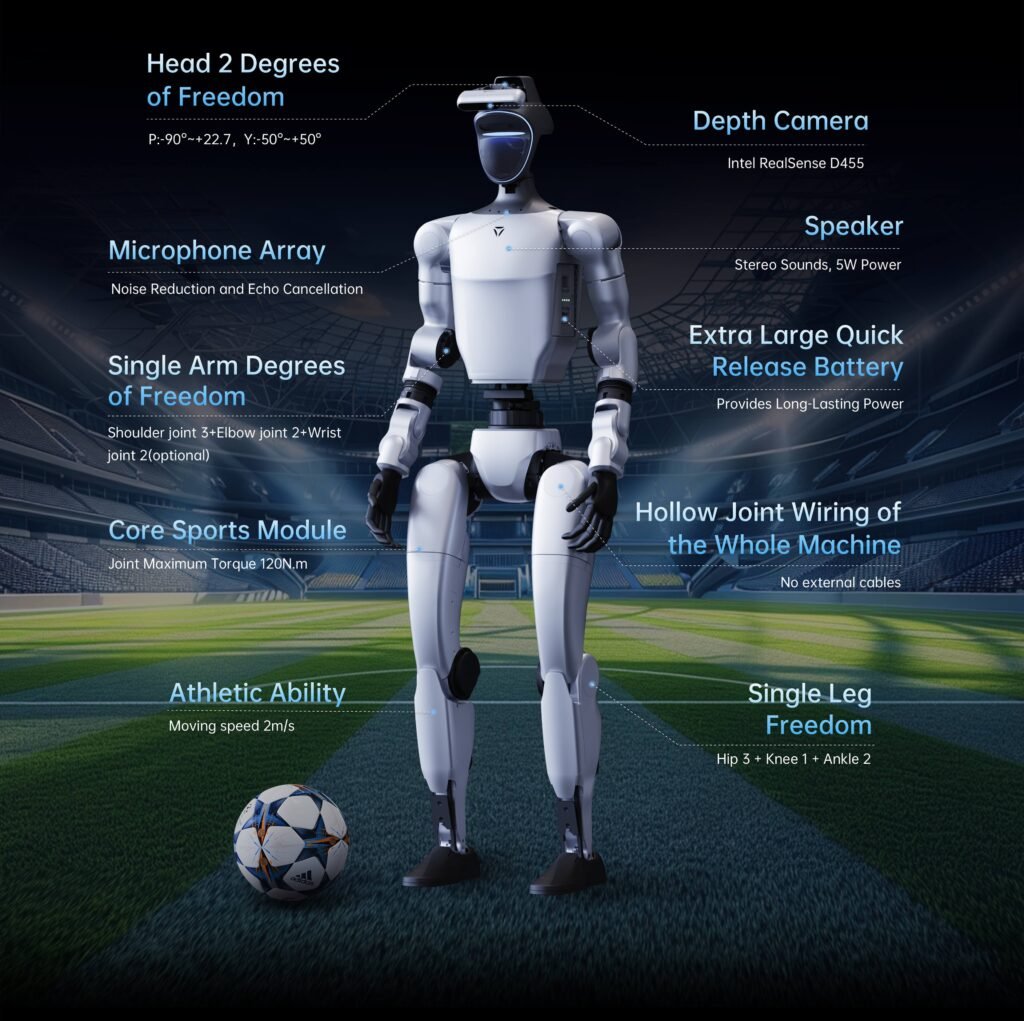
Key Innovations in Humanoid Robotics
Modern humanoid robots incorporate a range of advanced technologies that enhance their capabilities, including:
Artificial Intelligence (AI) for intelligent decision-making and adaptive learning.
Computer Vision for facial recognition, object detection, and environmental awareness.
LiDAR and Advanced Sensors for accurate navigation and obstacle avoidance.
Natural Language Processing (NLP) for voice recognition and human-like communication.
Precision Actuators that enable smooth movement, balance, and dexterous object handling.
Edge Computing and Cloud Robotics for real-time processing, remote updates, and fleet management.
These technologies allow humanoid robots to operate more autonomously while improving safety, accuracy, and overall efficiency.
Growing Industry Applications
As robotics technology matures, humanoid robots are finding practical applications across multiple sectors:
Manufacturing – Supporting assembly lines, quality inspections, and material handling.
Healthcare – Assisting with patient care, rehabilitation, hospital logistics, and elderly support.
Education & Research – Advancing AI research and providing interactive learning experiences.
Hospitality & Customer Service – Greeting visitors, answering queries, and enhancing customer engagement.
Logistics & Warehousing – Assisting with inventory management, order fulfillment, and warehouse automation.
The Future of Humanoid Robotics
The next generation of humanoid robots will become increasingly autonomous, collaborative, and intelligent. Advances in AI, battery technology, robotic mobility, and sensor integration will enable robots to perform more complex tasks while adapting to dynamic environments with minimal human intervention.
As organizations continue investing in intelligent robotics, humanoid robots are expected to play an increasingly important role in improving productivity, operational efficiency, and workplace safety. Their ability to work alongside humans, learn from real-world interactions, and perform complex physical tasks positions them as one of the most transformative innovations in the future of robotics.
The drone ecosystem is undergoing a rapid transformation driven by groundbreaking innovations in artificial intelligence (AI), sensor technology, and autonomous systems. Today’s drones are no longer simple flying cameras—they are intelligent aerial platforms capable of performing complex missions with minimal human intervention. With AI-powered navigation, real-time terrain analysis, and adaptive flight algorithms, drones can now understand their surroundings, predict obstacles, and adjust their course dynamically.
Beyond navigation, advancements in imaging technology have elevated data quality to unprecedented levels. Ultra-high-resolution cameras, LiDAR mapping systems, multispectral sensors, hyperspectral sensors, and thermal imaging cameras are enabling drones to capture detailed visual and geospatial insights. These features allow professionals to generate precise 3D models, detect crop stress, locate heat anomalies, and map vast terrains with exceptional accuracy.
Latest Drone Technology Breakthroughs
This section dives deeper into the latest advancements in:
Autonomous Flight & AI Integration – Drones that interpret data in real time, make intelligent decisions, and adapt to changing environments during flight.
Payload Innovations – Lightweight, high-performance payloads that expand mission capabilities across industrial, commercial, and research applications.
Camera & Sensor Upgrades – Advanced imaging systems engineered for scientific research, industrial inspections, mapping, and precision data collection.
Software-Based Flight Intelligence – Cloud-connected platforms offering smart mission planning, real-time monitoring, data analytics, and automated flight management.
New Drone Categories & Form Factors – Emerging technologies including FPV drones, hybrid VTOL drones, nano drones, fixed-wing drones, and autonomous UAV systems designed for specialized applications.
Together, these advancements in drone technology, AI-powered automation, and intelligent aerial systems are redefining the capabilities of modern drones and transforming industries such as agriculture, construction, energy, public safety, surveying, logistics, and infrastructure inspection.


The Future of Quadruped Robotics
The Future of Quadruped Robotics
Quadruped robots, commonly known as robot dogs, are redefining mobility in modern robotics by combining artificial intelligence (AI), advanced sensor technology, and agile mechanical design. Unlike traditional wheeled robots, quadruped robots are engineered to navigate uneven terrain, climb stairs, cross obstacles, and operate in environments where conventional machines often struggle. Their exceptional stability and adaptability make them ideal for missions that demand precision, reliability, and autonomous movement.
As robotics continues to evolve, quadruped robots are becoming increasingly intelligent through the integration of computer vision, LiDAR, machine learning, and real-time data processing. These technologies enable robots to understand their surroundings, avoid obstacles, identify hazards, and make informed decisions with minimal human intervention. Their ability to collect accurate data while operating in challenging environments is transforming industries that rely on inspection, monitoring, and autonomous operations.
Key advancements driving quadruped robotics include:
AI-powered autonomy for intelligent navigation and decision-making.
Advanced mobility systems designed for rough terrain and complex environments.
High-precision sensors including LiDAR, thermal cameras, and depth imaging.
Remote monitoring and cloud connectivity for real-time control and data analysis.
Today, quadruped robots are widely explored across industries such as energy, construction, mining, public safety, defense, manufacturing, and infrastructure inspection. They can perform routine inspections, monitor hazardous locations, support emergency response teams, and access confined or dangerous areas without exposing personnel to unnecessary risks.
The future of quadruped robotics lies in greater autonomy, improved energy efficiency, and seamless collaboration with humans. As advancements in AI, battery technology, and robotic mobility continue to accelerate, these intelligent robotic platforms will become increasingly capable of performing complex real-world tasks with greater speed and accuracy. By enhancing safety, reducing operational costs, and improving productivity, quadruped robots are set to become an essential part of the next generation of intelligent automation across industries.