DJI Matrice 4E vs Matrice 4T: Which One Actually Fits Your Job?
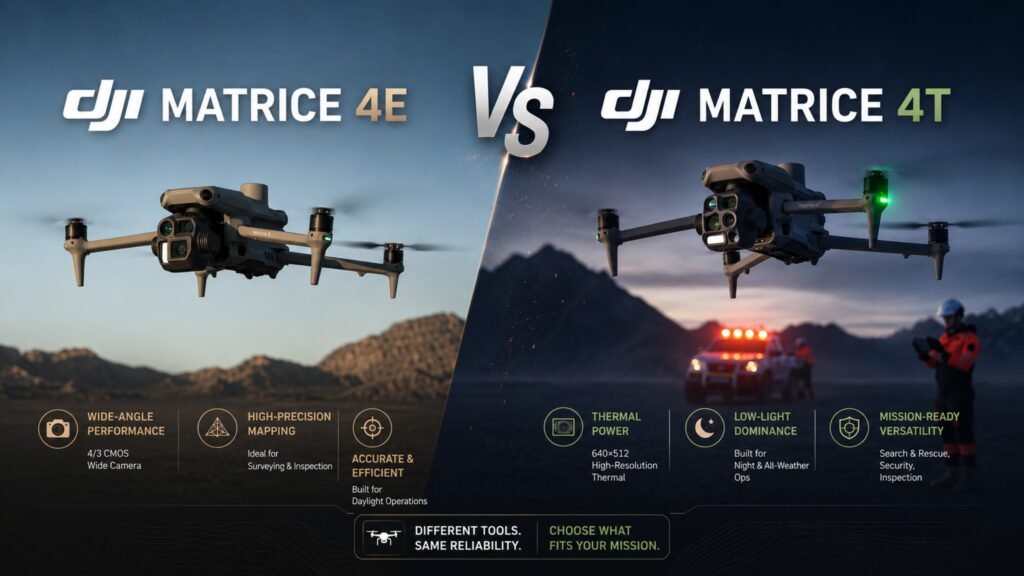
If you’ve been shopping around for a new enterprise drone, chances are the DJI Matrice 4 series has already crossed your radar. It’s the natural upgrade path for anyone still flying the M300 or M30, and DJI split the lineup into two distinct machines this time around: the Matrice 4E and the Matrice 4T. On paper they look almost identical — same airframe, same compact enterprise build, same intelligent flight features. But the moment you dig into what each one is actually built to do, the differences get a lot more interesting.
So which one should land in your hangar? Honestly, it comes down to one question: what do you need the drone to see?
The Short Version
If you had to sum it up in a sentence, it’d be this: the 4E is a mapping machine, and the 4T is a thermal-and-inspection workhorse.
The Matrice 4E carries a wide-angle camera setup that’s tuned for capturing clean, detailed aerial imagery at scale — exactly what you want when you’re stitching together maps or generating survey data. The Matrice 4T, on the other hand, adds a dedicated thermal sensor and infrared imaging to the mix, which opens the door to a completely different set of missions: electrical inspections, firefighting support, search and rescue, security work — anything where heat tells you something a regular camera can’t.
That’s the elevator pitch. But if you’re about to spend real money on enterprise hardware, you probably want more than an elevator pitch.
What the Matrice 4E Is Really Good At
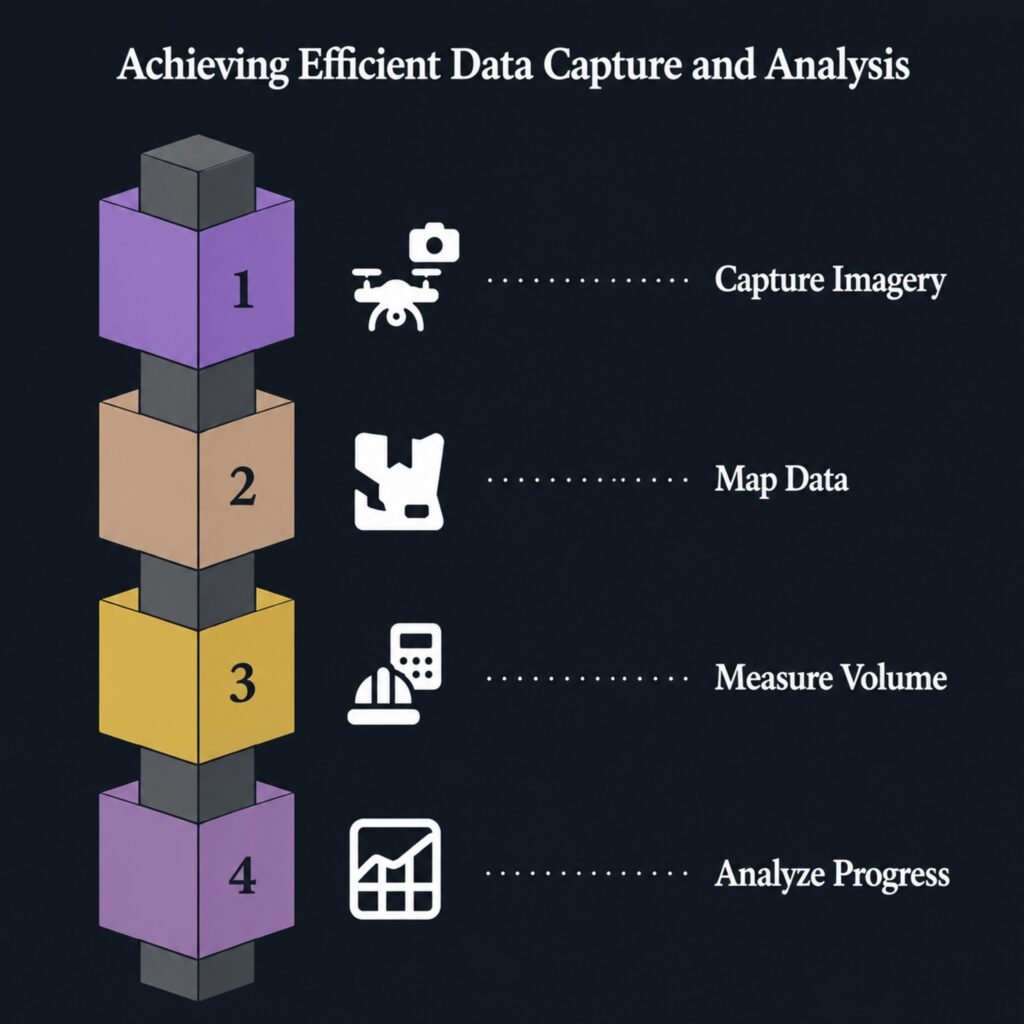
Think of the Matrice 4E as a tool built around a workflow, not just a spec sheet. Surveyors, construction firms, and geospatial teams don’t just want pretty aerial photos — they want data they can turn into maps, volume calculations, and progress reports without a ton of manual cleanup.
That’s where the 4E shines. Its camera system is optimized for the kind of large-area, high-consistency image capture that survey work depends on. A few places it tends to earn its keep:
- Land and topographic surveying
- Construction site progress tracking
- Stockpile and volume measurement
- Mining and quarry mapping
- Corridor mapping for roads, rail, or pipelines
- Agricultural land assessment
Picture a construction company running weekly flights over an active job site. Instead of sending someone out with a clipboard (or worse, a drone that wasn’t built for this), they fly the 4E, pull consistent imagery, and feed it straight into their mapping software. Progress documentation that used to eat up half a day now takes twenty minutes in the air.
If your business lives and dies by the phrase “capture, map, measure, analyze,” the 4E is speaking your language.
What the Matrice 4T Brings to the Table
Now flip the scenario. Say you’re not mapping a field — you’re checking whether a transformer is about to fail, or looking for a missing hiker in dense brush at 2 a.m. A wide-angle RGB camera isn’t going to cut it. You need thermal.
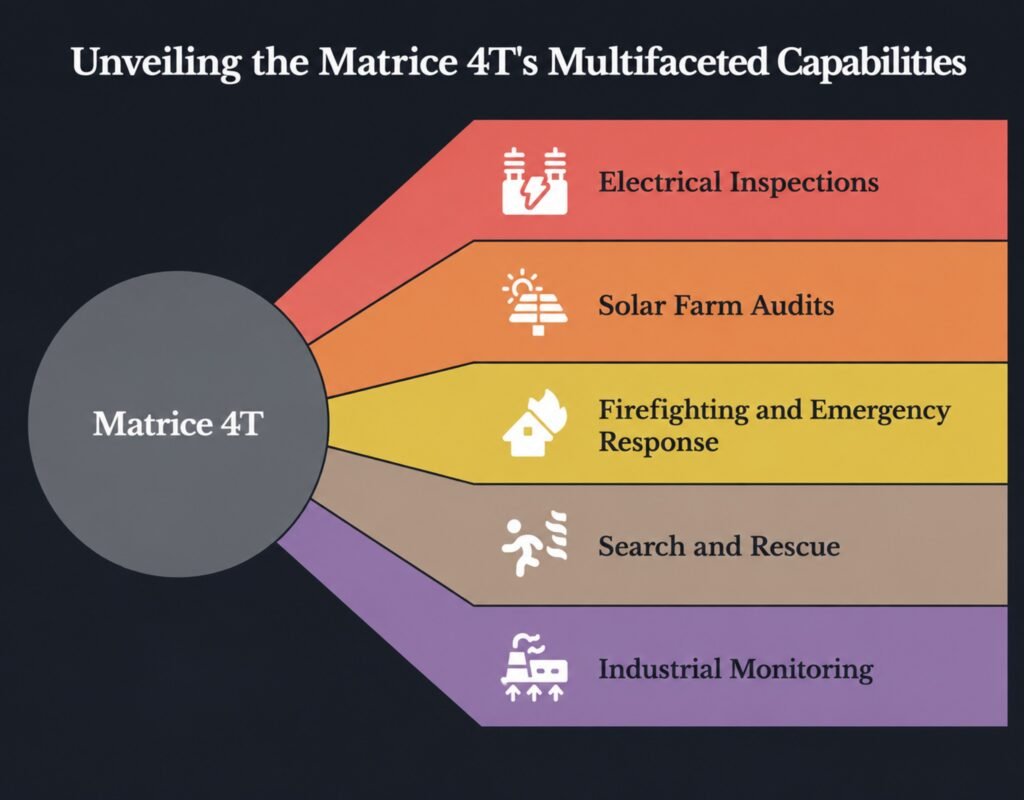
A few scenarios where that matters:
- Electrical inspections — spotting overheating components before they become a fire hazard
- Solar farm audits — catching hotspots on panels that look totally fine to the naked eye
- Firefighting and emergency response — seeing through smoke when visibility drops to near zero
- Search and rescue — picking up a heat signature in terrain where a person is otherwise invisible
- Industrial monitoring — flagging equipment running hotter than it should before it breaks down
The Matrice 4T is built around that need. It still handles visual imagery well, but its real selling point is the thermal and infrared payload layered on top of wide, medium-tele, and telephoto lenses (the exact combination depends on configuration). That gives pilots the ability to switch between “what does this look like” and “what does this feel like, temperature-wise” without changing aircraft.
Take a solar inspection as an example. A standard camera will confirm the panels are physically intact — no cracks, no obvious damage. But thermal imaging can reveal a hotspot buried inside a panel that’s quietly losing efficiency, something you’d never catch by eye. That’s the entire value proposition of the 4T in one example.
The Camera System Is the Real Dividing Line
If you’re trying to boil this decision down to one factor, make it the camera. Everything else — flight time, portability, safety features — is roughly comparable between the two aircraft. The imaging payload is where they genuinely diverge.
The 4E’s camera is purpose-built for mapping accuracy and efficient large-scale capture. The 4T’s is built for flexibility: hop between visual, zoom, and thermal depending on what the mission throws at you. An inspector might use the standard lens to check the physical condition of a power line, then flip to thermal to hunt for irregular heat patterns in the same flight. That kind of on-the-fly switching just isn’t something the 4E is designed to do.
Don't Sleep on the Zoom Capability Either
One thing that gets overlooked in these comparisons: a lot of enterprise inspection work involves objects you really don’t want to fly right up next to. Communication towers, bridges, wind turbines, high-voltage infrastructure — getting close carries risk, both to the equipment and the aircraft.
The telephoto range on the Matrice 4 series lets operators back off to a safer distance and still pull in tight, usable detail. If your work is inspection-heavy, this alone might tip the decision toward the 4T, since that platform leans harder into detailed, at-distance imaging paired with thermal confirmation.
So, Which One Should You Actually Buy?
Here’s the practical breakdown.
Go with the Matrice 4E if:
- Surveying and mapping are your bread and butter
- You’re working construction sites, mining operations, or land development
- Your output is maps, models, or measurement data
- Thermal imaging isn’t part of your regular workflow
Go with the Matrice 4T if:
- You’re doing infrastructure or electrical inspections
- Thermal data is a must-have, not a nice-to-have
- You work in public safety, firefighting, or search and rescue
- Night operations are part of your job
- You want one aircraft that can flex across multiple mission types
The Bottom Line
These two drones aren’t really rivals — they’re specialists. DJI didn’t build the 4E and 4T to compete with each other; they built them to solve two different problems really well. Buying the 4T because it has more sensors, when all you actually need is clean mapping data, means paying for capability you’ll rarely touch. And buying the 4E for inspection-heavy work means missing out on the thermal insight that often matters most.
The smartest move is to look honestly at what your team does week to week. What missions come up the most? What kind of data actually gets used once it lands on someone’s desk? Answer that, and the choice between the Matrice 4E and Matrice 4T basically makes itself.
If you’re still on the fence, it’s worth talking to an authorized enterprise drone dealer who can walk through your specific use case rather than guessing from a spec sheet. The right drone isn’t the one with the longest feature list — it’s the one that matches how you actually work.