Intelligent Motion and Perception in Unitree G1 Humanoid Robot
The Unitree G1 Humanoid Robot marks an exciting leap in advanced robotics, embodying a fusion of intelligent design and versatile functionality that pushes the boundaries of what humanoid machines can achieve. Measuring 1320 x 450 x 200 mm and weighing approximately 35 kilograms, this robot is engineered with exceptional joint mobility, powered by 23 to 43 high-performance motors depending on the configuration. Such mobility allows the G1 to perform fluid, human-like movements with remarkable precision, enabling it to navigate complex environments and execute tasks that require both speed and fine control. Its dexterity is further amplified by the optional three-fingered robotic hand, which can manipulate objects delicately and effectively, opening doors to diverse industrial, research, and educational applications.
The Unitree G1 is shaping the future of robotics by bridging the gap between theoretical research and practical, real-world applications. Its ability to perform intricate operations, interact naturally with humans, and safely navigate complex spaces positions it as a vital tool in industries such as healthcare, manufacturing, entertainment, and education. With ongoing software upgrades and expanding customization options, the Unitree G1 embodies not just technological excellence but also a commitment to creating friendly, versatile robots that enhance human lives and productivity. As the world embraces intelligent automation, the Unitree G1 stands at the forefront, ushering in a new era of humanoid robotics.
Design and Structural Features
When it comes to the design and structure of Unitree G1 , several critical elements set the foundation for their capabilities and overall effectiveness. The design not only defines the robot’s appearance but fundamentally impacts its mobility, dexterity, and the extent to which it can perform complex tasks in real-world environments. The best humanoid robots strike a careful balance between robustness and agility, integrating a host of technical innovations that bring human-like motion and interaction to life.
Human-Inspired Form and Proportions
The foundational design philosophy behind Unitree G1 robots centers on replicating human anatomy as closely as possible. This includes articulated arms, legs, a torso, and a head—all meticulously proportioned to facilitate seamless, natural movements that enable smooth interaction within human-centric environments. By mimicking the human form, these robots can operate effectively in spaces originally designed for people, such as homes, offices, and public spaces, without requiring costly or extensive modifications.Degrees of Freedom and Joint Architecture
To achieve lifelike motion, advanced humanoid robots Unitree G1 feature a sophisticated joint system with numerous degrees of freedom (DoF). Each joint acts as an independent pivot point, allowing complex movements such as grasping with fingers, precise bending at the elbows and knees, rotation of wrists, and even nuanced gestures like pointing or waving. This high DoF count provides the necessary dexterity and versatility for robots to adapt to diverse and dynamic real-world tasks—from manipulating delicate objects to navigating tight, irregular spaces.Materials and Build Quality
The choice of materials plays a critical role in balancing durability with agility. Humanoid robots are often constructed using cutting-edge carbon fiber composites and engineered lightweight alloys that provide excellent strength-to-weight ratios. This ensures that the robot can endure physical stresses, impacts, and daily wear—even in demanding industrial or research applications—while maintaining the nimbleness and speed required for fluid movement and extended operational lifespans.Compactness and Portability Considerations
Modern humanoid robots prioritize modularity and compact designs to support portability and ease of deployment. Innovative foldable or collapsible components reduce overall bulk, allowing the robot to be transported easily between locations and set up quickly without the need for specialist tools or lengthy preparation. This focus on portability enhances practical usability in various scenarios, including field research, education, and rapid deployment in emergency situations.Safety-Driven Design Elements
Safety is paramount in the design of humanoid robots, especially when operating alongside humans. Structural elements such as soft coverings on joints, use of compliant actuators that absorb unexpected forces, and integrated fail-safe mechanisms safeguard both the robot and users from accidental harm. These thoughtful designs enable humanoids to collaborate securely and intuitively with people, fostering trust and expanding their applicability in shared environments like homes, hospitals, and public spaces.
Mobility and Movement Capabilities
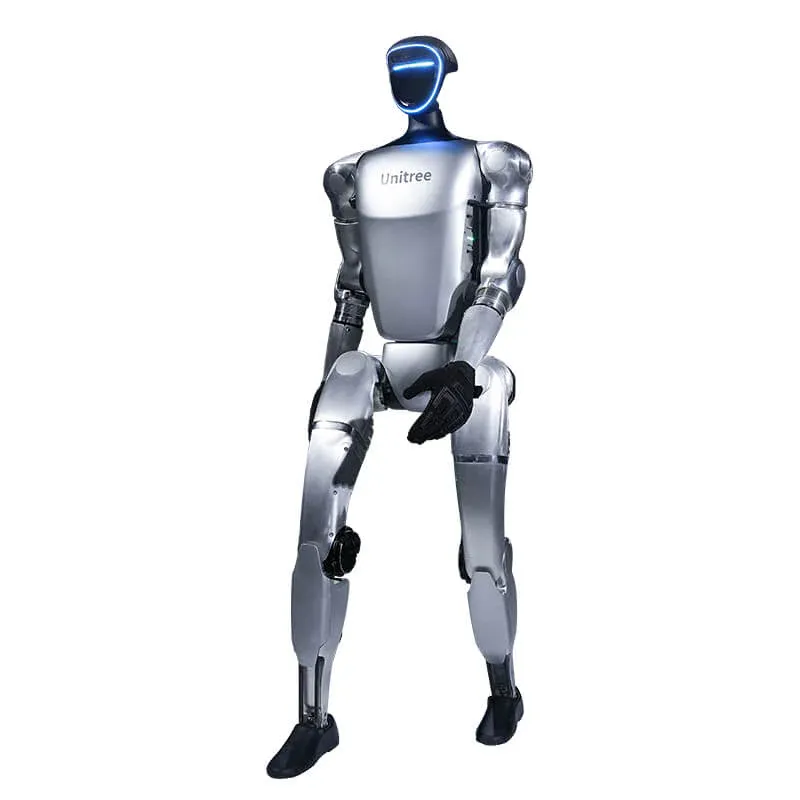
Unitree G1 represent a pinnacle of robotics engineering, and their ability to move with human-like fluidity defines much of their utility and appeal. Mobility in these robots is a complex orchestration of joint actuators, sensors, and advanced control algorithms that allow them to walk, run, and perform nuanced gestures with grace and precision. Unlike traditional robots fixed to a single task or location, humanoids must balance dynamic stability with flexibility, navigating diverse terrains and reacting in real time to changes in their environment.
A key component of Unitree G1 mobility is bipedal locomotion, which requires balancing the robot’s center of gravity and coordinating multiple degrees of freedom in leg joints. This enables robots to take precise steps, adjust posture, and maintain equilibrium even on uneven surfaces. The quality of motion control also extends to the upper body, where arms and hands execute delicate manipulations, opening doors, picking up objects, or signaling gestures, all requiring a sophisticated sensorimotor system that integrates visual, tactile, and proprioceptive feedback.
Advances in machine learning have dramatically transformed the movement capabilities of humanoid robots, enabling these sophisticated machines to learn and imitate human motion patterns with unprecedented accuracy. Through methods such as imitation learning, robots train by observing human behaviors and replicate them, resulting in fluid and natural movements that closely mirror human dexterity. This form of learning is augmented by reinforcement learning, where Unitree G1 improve their motor skills through trial and error, optimizing their performance based on rewards or penalties received during tasks. The integration of rich sensory data—from visual, tactile, and proprioceptive sensors—allows these robots to develop an acute awareness of their environment, adjusting their movements in real time to navigate complex and dynamic spaces safely and effectively.
Beyond simply mimicking human motion, machine learning equips humanoid robots with the ability to adapt and generalize across various scenarios. For example, when confronting unforeseen obstacles or novel tasks, reinforcement learning algorithms enable the robot to modify its actions flexibly without requiring explicit programming for every possible situation. This adaptive behavior significantly bridges the gap between human versatility and robotic precision, allowing robots to function autonomously in unpredictable environments.
Specifications
| Specification | Details |
|---|---|
| Dimensions | 1320 x 450 x 200 mm |
| Weight | Approximately 35 kg |
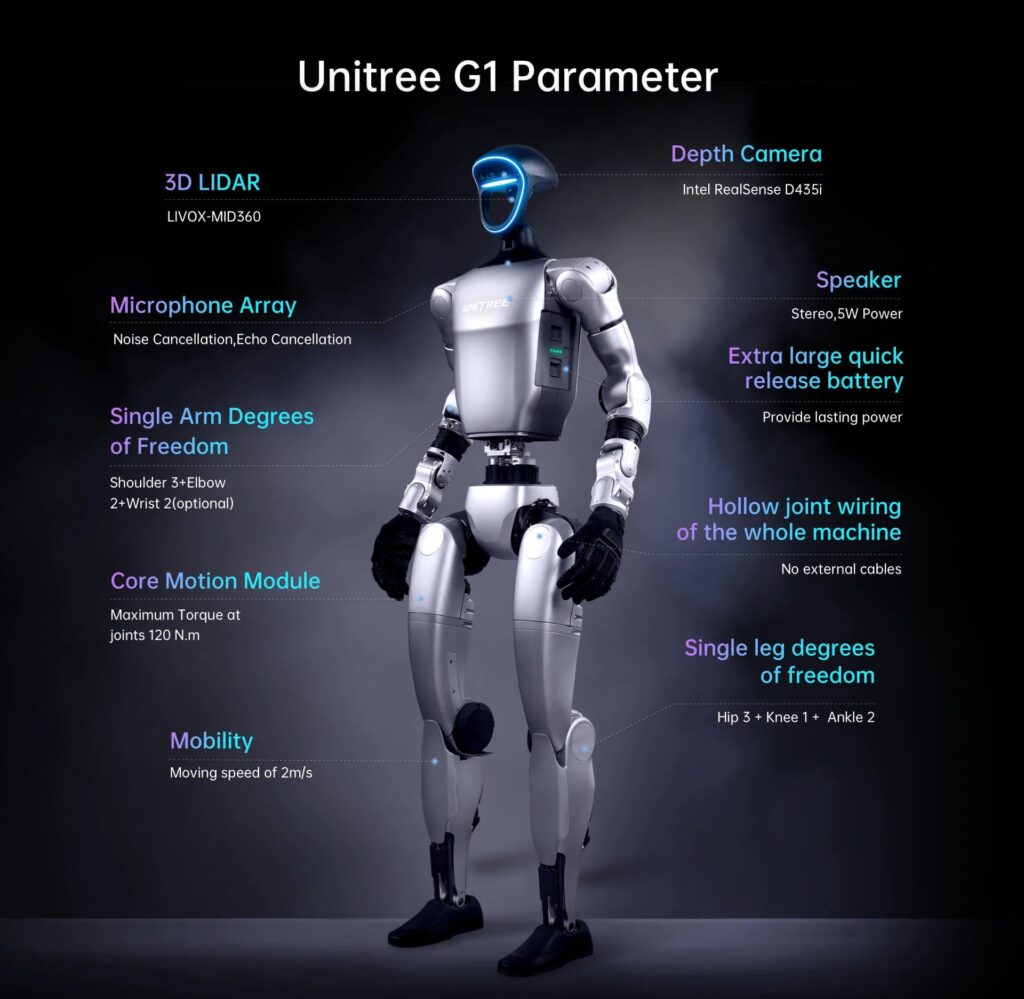
| Degrees of Freedom | 23 to 43 joints depending on configuration |
| Mobility | Bipedal locomotion with human-like walking, running |
| Actuators | High-performance servo motors |
| Sensor Suite | 3D LiDAR, depth cameras, microphones, speakers |
| Manipulation | Optional 3-finger robotic hand with dexterous control |
| Battery Life | Up to 2 hours continuous operation |
| Processing Unit | Integrated onboard computer with AI capabilities |
| AI Features | Imitation learning, reinforcement learning, OTA updates |
| Communication | Wireless remote control and data transmission |
| Safety Features | Environmental awareness, obstacle detection |
| Application Areas | Research, manufacturing, education, healthcare |
Control and Artificial Intelligence
The control systems and artificial intelligence (AI) embedded within Unitree G1 are at the forefront of what makes these machines functional, adaptive, and intelligent. A humanoid robot’s control architecture is designed to process vast amounts of sensory data in real-time, coordinating complex motor actions with a high degree of precision and flexibility. This is achieved through layered control frameworks that integrate low-level actuator commands with higher-level decision-making algorithms, enabling fluid movement, balance, and interaction with the environment.
Artificial intelligence plays a crucial role by endowing these Unitree G1 robots with the ability to learn from experience, adapt to new situations, and perform tasks autonomously. Techniques such as imitation learning allow humanoids to acquire skills by observing human behavior, while reinforcement learning helps them optimize their actions through trial and error. AI also drives perception capabilities, enabling robots to interpret visual, auditory, and tactile inputs to make informed decisions. These intelligent systems support multitasking and complex behaviors, including navigating unfamiliar spaces, manipulating objects, and collaborating with humans safely and efficiently.
Modern humanoid robots often come equipped with powerful onboard processors and support for over-the-air (OTA) software updates, allowing continuous improvements in their AI algorithms. The software ecosystems are typically designed with robust developer tools and APIs, fostering innovation and customization. This seamless integration of advanced control and AI technologies is what propels humanoid robots from static machines to dynamic, interactive agents capable of meaningful engagement across diverse applications such as healthcare, manufacturing, service industries, and research.
Conclusion
Unitree G1 have rapidly evolved from mere prototypes to sophisticated entities capable of intricate movements, intelligent interactions, and autonomous decision-making. Their design, rooted in replicating human anatomy, allows them to seamlessly integrate into environments built for people, making them versatile tools across diverse sectors. Innovations in materials, joint architecture, and safety features have made these robots more resilient, responsive, and capable of performing complex tasks with agility and finesse.
Advances in machine learning and artificial intelligence have been instrumental in unlocking the true potential of Unitree G1. These technologies enable Unitree G1 to learn from their environment, imitate human motion patterns, and continuously improve through experience. With the integration of sensory systems and robust control algorithms, humanoid robots can adapt dynamically to unpredictable environments, undertake multitasking, and engage confidently in social interactions.
As research and development accelerate, the future of humanoid robots look promising, with their applications expanding into healthcare, manufacturing, disaster response, and even companionship. Their capabilities are no longer limited to static, repetitive tasks but are increasingly oriented towards dynamic, context-aware, and autonomous operation. . In essence, these advancements mark the dawn of a future where technology seamlessly augments human potential, making our lives more efficient, safer, and more enriched.